Antarctica’s ice-free areas represent less than 0.5% of the continent’s surface, yet they host nearly all terrestrial biodiversity and most human infrastructure, such as scientific stations and former sites of human activity. These regions are both ecologically sensitive and particularly vulnerable to the effects of climate change.
In this study, the researchers carried out a comprehensive review of trace elements in soils from Antarctica’s ice-free areas, examining concentrations in pristine zones and in areas influenced by human activity, with special emphasis on the impact of permafrost thaw on their mobilization. Antarctica was divided into six regions with similar climatic and environmental characteristics, allowing results to be compared, natural and anthropogenic sources of contaminants to be distinguished, and vulnerable areas requiring future monitoring to be identified.
The results showed that the active layer of permafrost controls the accumulation and mobility of trace elements in Antarctic soils and that permafrost thaw associated with climate change can remobilize previously retained contaminants, increasing their environmental availability.
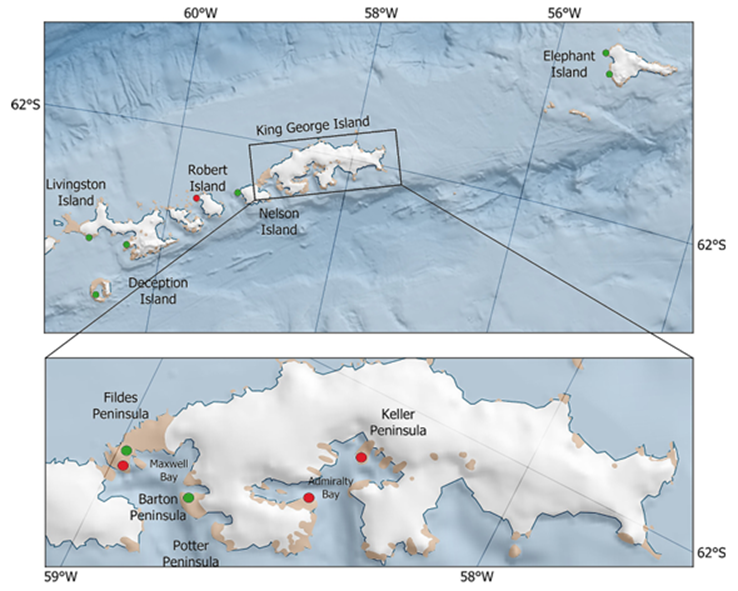
Furthermore, concentrations of elements such as Hg, Pb, Cd, Cu, Cr, and Ni arise from both natural and anthropogenic sources. In the South Shetland Islands, particularly on King George Island, higher values are recorded near scientific stations, waste sites, fuel spills, and other human infrastructures, whereas on Deception Island, volcanic activity leads to naturally elevated concentrations of Hg and As, with permafrost potentially acting as a temporary reservoir for these elements (Fig. 1). Scientists also noted that glacier retreat, increasing active-layer thickness, and permafrost degradation are altering hydrological dynamics and contaminant transport.
The combined effects of human pressure and climate change pose a growing risk to terrestrial and coastal ecosystems, underscoring the need for continuous monitoring.
Source: Zilhão, H., Cesário, R., Vieira, G. & Canário, J. (2025). Trace elements in soils of the Antarctic ice-free areas: Insights on natural geochemical values, anthropogenic impact and possible remobilisation upon permafrost thaw. Earth-Science Reviews, 268.
Author: Diana Vaz