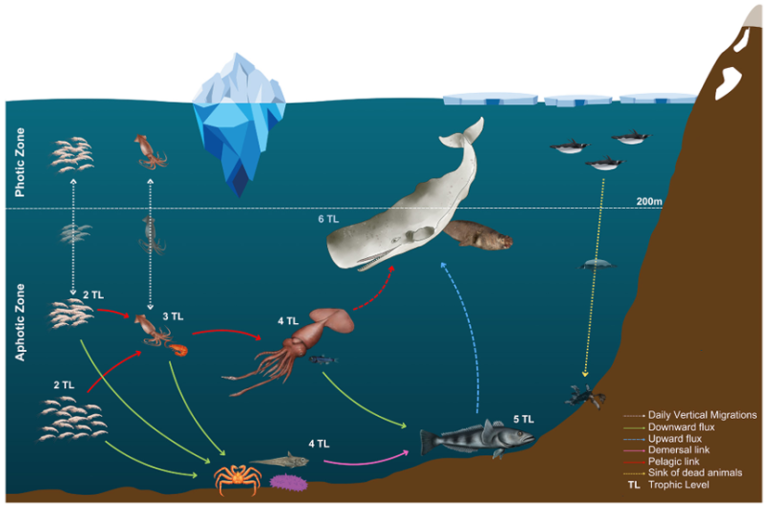
Cephalopods (squid and octopods) play an essential role in the Southern Ocean’s ecosystem, acting as a link between lower trophic levels and top predators. However, their ecological role in the Pacific sector of this ocean is still poorly understood, specifically their habitat and trophic position within the marine food web. Why is that? Because of the capacity of larger cephalopods to evade scientific nets, making it hard to catch live specimens to address these questions. Then how to overcome these issues? To address this, researchers used cephalopod beaks collected from predator stomach contents.
But how did they do it? In this study, the scientists turned to eastern rockhopper penguins (Eudyptes chrysocome filholi), from Campbell Island (a sub-Antarctic island of New Zealand) as a biosampler. Researchers collected cephalopods’ beaks from their diet from two breeding seasons (1986–87 and 2012–13) in which they performed stable isotope analysis (SIA), forms of chemical elements that do not undergo radioactive decay. Using this method, they were able to examine the carbon (δ¹³C) and nitrogen (δ¹⁵N) isotopic signatures, which provide insights into the habitat and trophic level of organisms. δ¹³C values help to differentiate between inshore and offshore foraging habitats, while δ¹⁵N values indicate the organism’s position in the food web.
What did they find? Using the beaks, scientists were able to pinpoint the differences in cephalopod biodiversity in the diet of penguins between the two breeding seasons. The 1986-87 diet comprised seven cephalopod species while, contrastingly, the 2012-13 diet included only three species: Moroteuthopsis ingens, Nototodarus sloanii, and Octopus campbelli. Moreover, M. ingens and O. campbelli were present in both seasons, but N. sloanii was only found in the 2012-13 season. And what does this mean? Firstly, the overall diversity seemed to decrease, however, this is likely due to the smaller sample size (Nº1986-87= 69 vs Nº 2012-13= 11). Secondly, the identification of N. sloanii may indicate a southward habitat expansion, as this species is more common in the warmer waters of New Zealand.
What about the SIA? These revealed variations in habitat and trophic niches between species. Specifically, M. ingens showed no significant differences in δ¹³C or δ¹⁵N values between years (Figure 1), while for O. campbelli δ¹³C and δ¹⁵N values were significantly lower in 2012-13 compared to 1986-87 (Figure 2), suggesting a shift in foraging location and possibly a move to lower trophic levels. N. sloanii, presented δ13C values in accordance with the values of other sub‑Antarctic waters taxa and lower δ15N values indicative of foraging at lower trophic levels.

What does this mean? The differences in stable isotope values between seasons could be a sign of changes in oceanographic conditions such as warming waters, taking species to new habitats and feeding differently. Additionally, the presence of N. sloanii in diets offers insights into their foraging and possible interactions with New Zealand fisheries, which can affect both the fisheries and the conservation of the eastern rockhopper penguin.

Overall, this study contributes significantly to increasing the knowledge of cephalopod ecology in the Pacific sector of the Southern Ocean. It demonstrates that different cephalopod species exhibit distinct habitat preferences and trophic roles. The findings reinforce the importance of continued monitoring of cephalopod populations, particularly in the face of environmental changes that may alter their distribution and availability to predators like rockhopper penguins.
Source: Guímaro, H. R., Thompson, D. R., Morrison, K. W., Fragão, J., Matias, R. S., & Xavier, J. C. (2025). Evidence of eastern rockhopper penguin feeding on a key commercial arrow squid species. Polar Biology, 48(1), 1-7
Author: Lucas Bastos