South Georgia’s waters are among the most productive in the Southern Ocean, supporting longline fisheries that target Patagonian toothfish. However, during these operations, four species of grenadier Macrourus caml, Macrourus carinatus, Macrourus holotrachys and Macrourus whitsoni — are regularly caught as by-catch. Moreover, despite being commonly mentioned in fishing records, these species have until now been identified only to genus level, preventing any distinction between the four species. This aggregation masks the important biological differences between them and the true extent of the effects of by-catch.
In this study, researchers carried out the first comprehensive biological assessment of all four Macrourus species caught in South Georgia waters, using fishery and observer data collected between 2018 and 2022. By analysing distribution patterns, depth preferences, sex ratios and habitat associations, the team was able to characterise each species individually and assess their respective vulnerabilities to fishing pressure.
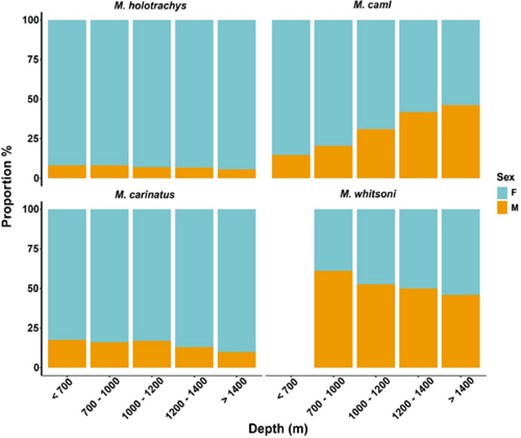
The results revealed striking differences between species. Three of the four showed female-biased sex ratios, which has direct implications for stock productivity and reproductive capacity. Each species also occupied a distinct depth range and geographic distribution: M. holotrachys was the most frequently caught and ranged widely between 1000 and 1750 metres; M. caml showed the greatest flexibility in habitat use; M. carinatus was concentrated in the western region; and M. whitsoni was rarer, found mostly in deeper waters beyond 1500 metres in the northeast and east.
These findings highlight a significant gap in how by-catch is currently managed. Reporting species collectively at genus level masks the fact that each faces different levels of risk, and that the health of the target fishery is not a reliable proxy for the condition of non-target species. The authors argue that species-level monitoring and accurate data collection are essential for setting meaningful by-catch thresholds and ensuring the long-term sustainability of toothfish fish fisheries across the CCAMLR area.
Source:Abreu, José, et al. “Distribution and ecology of the four Macrourus species by‐caught in the longline fishery at South Georgia, Southern Ocean.” Journal of Fish Biology (2026).
Author: Lucas Bastos