Cephalopods play a key role in marine ecosystems, acting as both predators and prey for numerous marine animals. However, many species are difficult to study directly, particularly in the Southern Ocean. Because cephalopod beaks are resistant to digestion, they frequently remain in predator stomach contents and provide an important source of information on cephalopod distribution and ecology. Traditionally, species are identified from beak morphology, a method that requires considerable taxonomic expertise and can become challenging when beaks are degraded or fragmented.
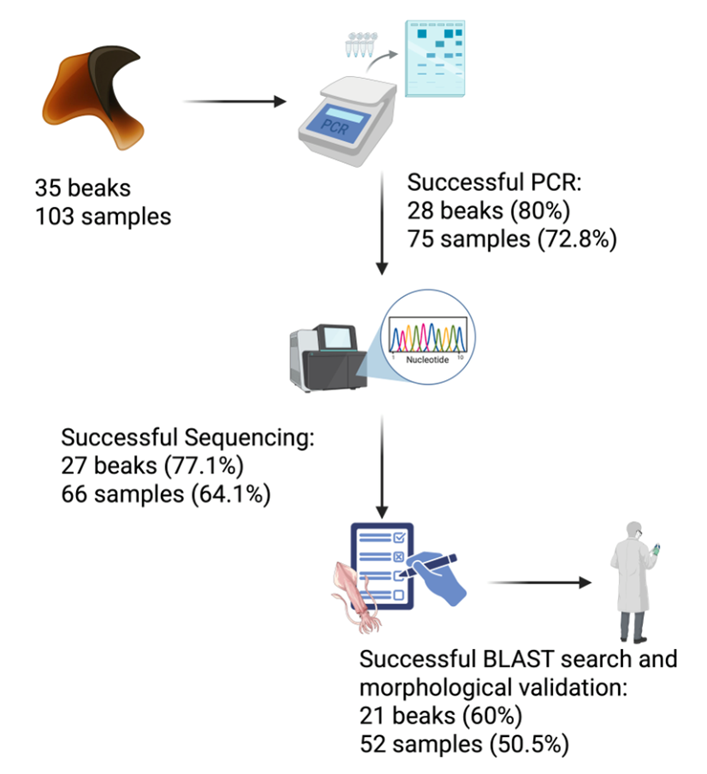
In this study, a molecular approach was developed and tested to identify cephalopods using DNA obtained directly from their beaks. Thirty-five beaks representing 10 Southern Ocean cephalopod species were analysed. Samples originated from different sources, including cephalopods collected in scientific nets and beaks recovered from the stomach contents or boluses of albatrosses, penguins and Dissostichus toothfish. Most beaks were divided into three different sections, allowing the researchers to test whether the region sampled influenced identification success. In total, 103 samples were processed.
Extracted DNA was used to amplify a 658-base-pair fragment of the cytochrome c oxidase I (COI) gene, a marker commonly used for DNA barcoding. Successfully amplified samples were Sanger sequenced, and the resulting sequences were compared with genetic reference databases, including GenBank and BOLD, for taxonomic assignment. A sequence similarity threshold of 97% was used for species-level identification.
PCR amplification was successful in 72.8% of samples, corresponding to 80% of the analysed beaks. Overall, molecular identification agreed with previous morphological identification for 50.5% of individual samples and 60% of the beaks. An additional 12 samples showed sequence similarities above 90%, allowing at least family-level identification.
Identification success was not significantly affected by beak section, storage condition or bleach treatment. This is particularly useful because it suggests that researchers may not need to target a specific part of the beak for molecular analysis, allowing other morphological features to remain intact for conventional identification.
Although sample origin could not be formally compared statistically, differences in identification success were observed. Samples recovered from albatrosses had a lower success rate (27.3%) than those obtained from Dissostichus stomach contents (59.5%) or cephalopods collected in scientific nets (55.6%). Its suggested that the highly acidic digestive system of albatrosses and environmental exposure of regurgitated beaks may contribute to greater DNA degradation.
Overall, this study demonstrates for the first time that DNA extracted directly from cephalopod beaks can be successfully used for species-level identification. This molecular approach can complement traditional morphological identification, particularly when beaks are fragmented or degraded or when species have very similar beak structures. Expanding genetic reference databases to include more species, populations and genetic markers could further improve the effectiveness of this method, providing new opportunities for studying predator diets, marine food webs, biodiversity and ecosystem change.
Source: Lucas Bastos, Charlotte Havermans, José P. Queirós, Mark Belchier, Phil Hollyman, Richard A. Phillips, Yves Cherel & José C. Xavier. Decoding diets: a novel DNA-based approach for identifying cephalopods from beaks. Frontiers in Marine Science, 13:1873859, 2026
Author: Sara